how to win the startup lottery
...by starting your own company
I left FAANG to join Instacart because I thought I was going to win the startup lottery.
It seemed likely: when I joined in January 2019 Instacart was already a unicorn, with a valuation of $7.6 billion.
We were in a prime growth position back then. The total market for online grocery in the United States is $285 billion. Instacart was a name brand in the Bay, where almost everyone is an early adopter, but unheard of in less tech-savvy locations. The idea of doing your weekly grocery shopping all via app was just gaining traction, and at the time, we had little serious competition. If we could position itself as the leader in online grocery, there was huge upside potential.
After just two years at Instacart, I saw its valuation skyrocket to $39 billion. COVID turned us into a household name. My equity grew 5x, and I wasn’t even an OG employee.
In our team sync meetings, my coworkers would chat about how they’d invest all the paper money they’d amassed: McMansions in chic locales, FIRE, finally being able to afford to start a family.
And then came the downrounds.
A year later, we were back to $10 billion.
Watercooler talk went from joy at finally being able to buy a house in the Bay Area to how our S-team was going to make us whole after doling out offers, promotion grants, and equity refreshers at an inflated valuation.
As a relatively early employee, I wasn’t underwater, unlike many of my coworkers who left FAANGs to join the Instacart rocketship at its peak. The most chagrined of them boomeranged back to the Metas and Googles from whence they came: public company money may not buy you a house in the Bay, but it pays the rent.
We’ve seen some early indicators that the party is over in Big Tech.
The startup lottery is seeming more and more like an actual, Mega Millions-style lottery: don’t count on winning, because the odds aren’t good.
Not only that, there are early signs that investors are starting to take issue with the stock-based compensation model) that has become the gold standard in Big Tech. The more shares the company gives to its employees, the less the investors stand to gain in a future exit.
There goes your FIRE money.
So what’s next?
If you have your ear to the ground, you’re aware of a burgeoning trend: these disillusioned and laid-off tech workers are starting their own companies. Venture is starting to catch on, too: I’ve come across some funds that are looking to invest in laid-off tech workers, like Funded Not Fired from Day One Ventures.
Instead of betting on the startup lottery, you’re thinking if you should do the same.
I ran a poll on Blind, the “#1 Tech Career Community” for those unfamiliar with it. Blind is much maligned for its “TC or GTFO” toxicity, but it’s an irreplaceable resource for anyone who wants to have a frank discussion on life in big tech.
It’s the town square of the disrupter demographic described in that WIRED article.
I asked this pool of talented, potential disrupters what was stopping them from starting a company.
And the results surprised me.
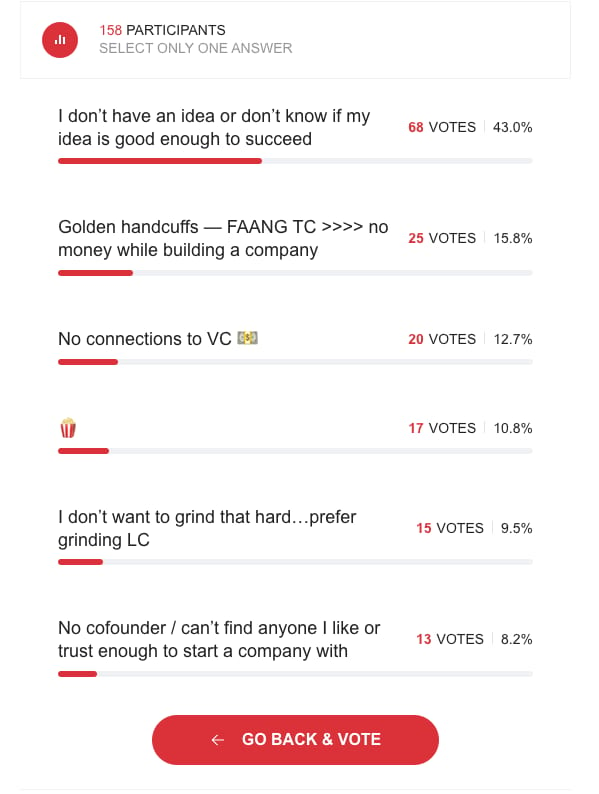
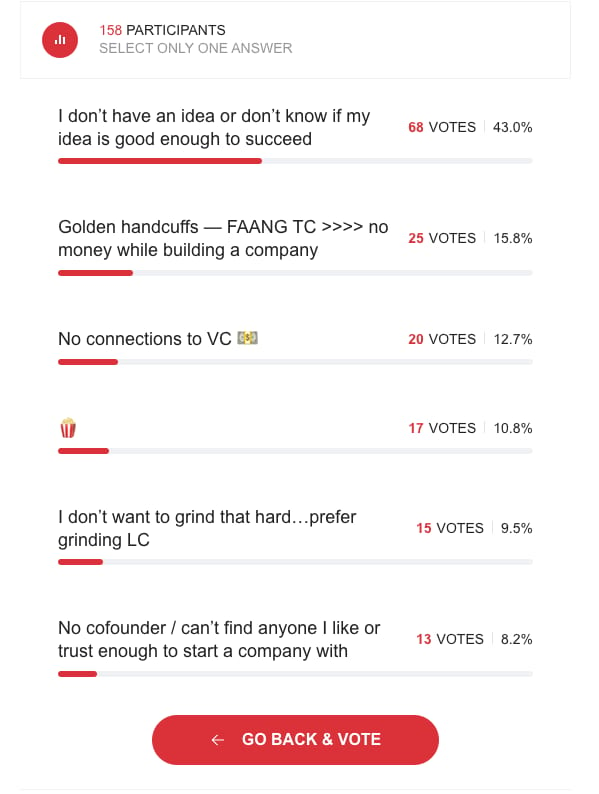
A whopping 43% of the respondents aren’t founding companies not because they’re fine without the grind, or because they’re not hooked in to the VC ecosystem: it’s because they don’t know what to build.
Back to the thought experiment.
You’re a good position to try being a founder.
You’ve been in Big Tech for years: you know how to write code and architect systems. Not only that, you have a keen eye for product and may have picked up some design chops from working on cross-functional teams. You can read the results of an A/B test, and know what metrics to look at when making a decision on what features to ship.
You even have a few ideas. Maybe a calendar application, because no one has quite figured out scheduling yet (though Clockwise comes close).
The ideas you have are the B2C low-hanging fruit sort. You’ve been in the game long enough to know that investors love SaaS and are default skeptical of anything consumer-facing. And you don’t want to spend your nights and weekends on what will ultimately amount to a Resume Project.
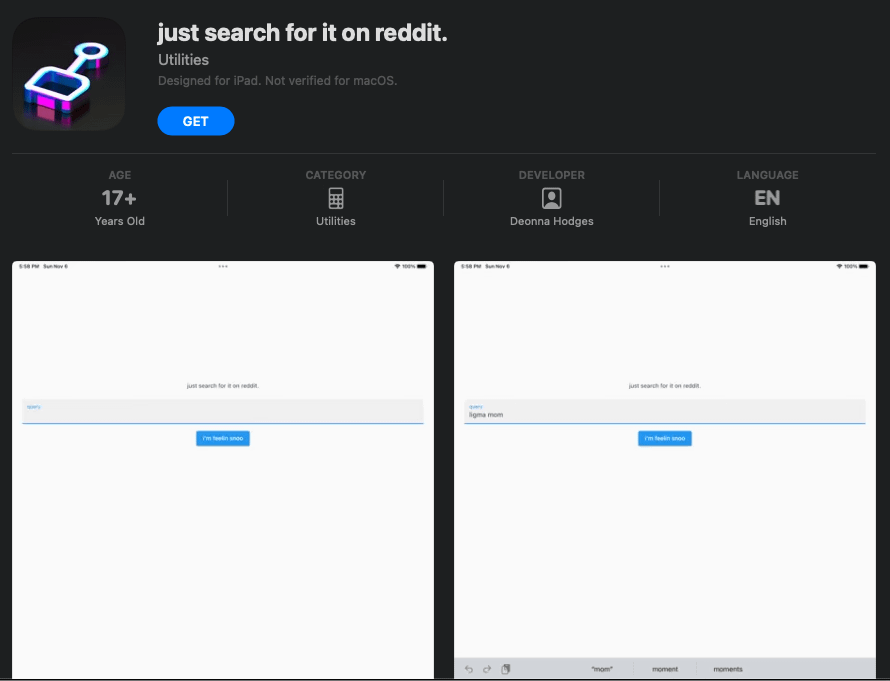
The Resume Project: app ideas that fail to make any money, and whose only purpose is to show your passion for programming to hiring managers when they glance at your GitHub graveyard
You have a hard time finding an idea that potential investors, and more importantly, you, are able to build conviction for.
So how do you do it? What’s the easiest way to generate ideas that you know people will pay for?
By talking to them.

 Tiktok failed to load.
Enable 3rd party cookies or use another browser
Customer interviewing is a skill that few engineers have despite spending their entire years building things for the customer.
In my eight years in the industry, I can count on one hand the number of times I’ve gotten real feedback from people who have used the products I worked on.
I’ve sat in on a few user experience research (UXR) sessions, but was explicitly discouraged from talking directly to any of the participants.
That was okay when we were working for companies that had researchers on staff whose job it was to ask those questions. But as a solopreneur in search of an idea, it’s a no-go.
Over the next few weeks, I’ll be posting about my own journey learning how to source ideas from people in industries I’m still learning about in order to generate viable software ideas.
I’ll be including the resources I used to quickly ramp up on on industry (starting with trucking) as well as snippets and scripts of my customer interviews.
This process has been helping me tremendously in my own search for the perfect SaaS idea, and hopefully it will help you, too.
Our financial independence is at stake.
liked this? watch the build.
new builds every week. or get the occasional email below.